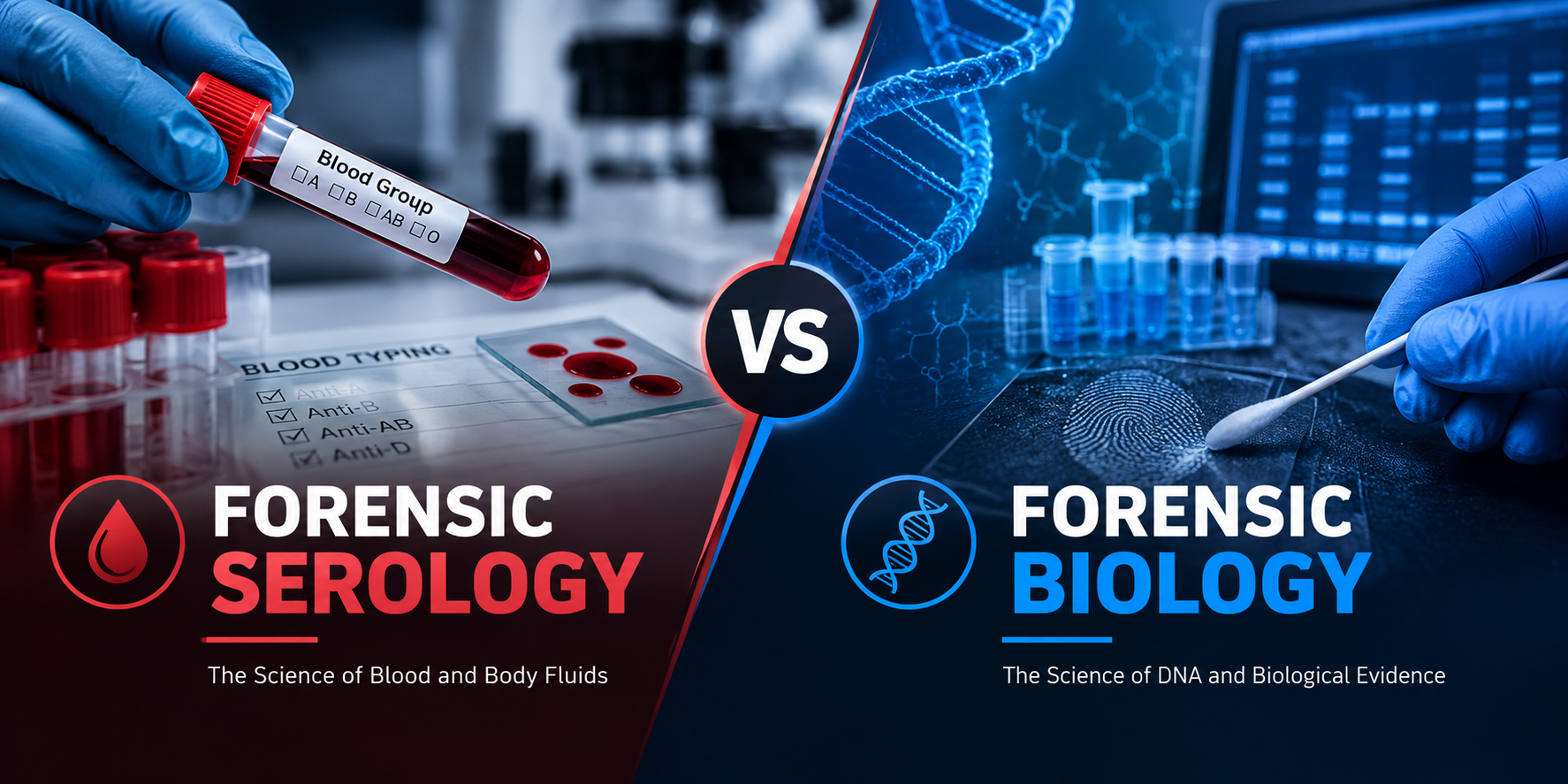
Forensic Serology vs Forensic Biology
Are you interested in forensic science but have no idea which specialisation to choose? While surfing google to find an answer to this question, you might have stumbled upon terms like forensic biology, forensic serology and forensic DNA. They feel similar and in practice they often overlap, but they stand apart.
The easiest way to understand the difference is this: forensic biology is the broader field, while forensic serology focuses mainly on identifying and examining biological fluids and tissues. DNA analysis is another major part of forensic biological evidence examination.
It is important for students to appreciate this difference as well as to make a choice whether they want to do an M.Sc. Forensic Science with Forensic Biology, Serology and DNA or not.
What is forensic biology?
Forensic biology is the application of biological and biochemical information to the investigation of crime. This may include examining biological material that has been recovered from a crime scene and determining what information it can provide about an investigation.
The field can involve the examination of biological evidence such as blood, saliva, semen, hair, skin cells and tissue. DNA analysis has become an important aspect of this work as biological evidence may occasionally be able to yield a DNA profile to help associate or exclude an individual as a possible source.
Forensic biology isn't just about DNA, in other words. It is a broader field that utilizes the principles of biology, biochemistry, molecular biology and other scientific methods to study information.
What is forensic serology?
Forensic serology deals more specifically with the detection, identification and examination of biological fluids and tissues found as stains or residues.
Evidence that can be used in a forensic serology examination can include blood, semen or saliva. Screening tests and confirmatory tests can be performed to identify if a specific biological material is in a sample.
This distinction is important since the presence of DNA alone does not necessarily mean that it is from a biological material. A DNA profile can provide information about whose DNA may be present, but it does not by itself establish which biological fluid produced the stain. Additional testing may be used to identify the biological material or body fluid.
This is one of the reasons why forensic biology and serology are intertwined in the lab.
Forensic serology vs forensic biology: Key difference
Forensic Biology |
Forensic Serology |
|---|---|
Broader application of biological science to forensic questions |
More focused on biological fluids and tissues |
Can include DNA, molecular biology and other biological evidence |
Commonly examines blood, semen, saliva and other body fluids |
Covers a wider range of biological evidence |
Often forms part of the examination process before or alongside DNA analysis |
Uses biological and biochemical techniques |
Uses screening, identification and typing methods |
So, if you are comparing forensic serology vs forensic biology, you can understand it as: serology is a more specialised area within the broader biological side of forensic science.
Where does forensic DNA fit in?
Forensic DNA is closely related to both but its methods and uses are also specialised. Blood, saliva, semen, cells of skin and hair, and tissue are all suitable sources for DNA. DNA analysis of suitable samples can yield a profile that can be used to compare against reference samples.
Serological testing can help identify or characterise the biological fluid or tissue present, while DNA analysis can provide information about the genetic profile associated with the sample. This is why forensic DNA and serology are usually studied and utilized together and not as separate fields.
What do you study in an M.Sc. Forensic Science with Forensic Biology, Serology and DNA?
For students seeking an M.Sc. Forensic Science with Forensic Biology, Serology and DNA, they need to take a careful look at the course curriculum and not just the name of the course. Forensic biology, serology, DNA profiling, molecular biology, genetics, immunology, laboratory techniques and evidence handling are all components of a strong curriculum on biological-forensics.
Is M.Sc. Forensic Biology different from forensic serology?
As mentioned above, forensic serology may be taught as part of a broader forensic biology or forensic science programme, depending on the university. The names of the courses, however, differ from one university to another. A programme that focuses on forensic biology may be offered in one institution or forensic biology, serology and DNA profiling could be offered in a broader M.Sc. Forensic Science programme in another institution.
So, it's important for students to pay more attention to the subjects, lab training, practical sessions, specialisations and research projects than to the name of the degree.
Which field should one choose?
Forensic biology is a field to explore if you have a passion for biology and the process of how it can help in an investigation. Blood analysis and laboratory testing of the blood may be of particular interest if you are interested in body fluid identification, a forensic serology.
If molecular biology, genetics and the identification of individuals through biological evidence is your preferred field of specialisation, then forensic DNA might be of interest. These 3 professions don't compete against each other. They are linked components of the biological aspects of forensic science.
Who should NOT study Forensic Biology or Forensic Serology?
Forensic biology and forensic serology are interesting specialty areas of forensic science, but not for everyone. These specialisations may not be suitable for students who do not enjoy laboratory work, biological samples, repetitive testing or detailed scientific analysis.
Patience and attention to detail are also important for these fields. Because evidence handling, documentation and analysis require accuracy, students who dislike detailed laboratory procedures and careful record-keeping may find these specialisations less suitable.
Also students interested in forensic science primarily because they love the idea of solving crimes shown in movies and TV but dislike biology, chemistry, genetics and scientific investigation should know the truth about the practice before opting for the specialisation.
Students looking for a course that leads to one clearly defined job should also understand that forensic biology and serology can lead to different roles depending on qualification, specialisation, practical training and the organisation they eventually join.
Key Advise
Students are advised to take the time to consider the nitty gritty of the science behind the forensic evidence before deciding on forensic biology, serology, DNA or any of the other forensic specialisations, and ask a simpler question: Do I really enjoy the science behind the evidence? If the answer is no, another aspect of forensic science might be a more academic match. Connect with AIFSET’s expert counselors @08035018480 and get free career consultation.
FAQs
1. What is the difference between forensic serology and forensic biology?
Forensic biology is the broader study of biological evidence in criminal investigations, while forensic serology focuses mainly on identifying and examining biological fluids such as blood, semen and saliva.
2. What does a forensic serologist do?
A forensic serologist examines biological fluids and tissues recovered as evidence, using laboratory tests to identify and analyse biological material that may be relevant to an investigation.
3. What does a forensic biologist do?
A forensic biologist examines biological evidence using biological, biochemical and molecular techniques. Their work can include DNA analysis, biological evidence examination and laboratory research.
4. Which course is better for a career in forensic serology or forensic biology?
There is no single course that is better for everyone. Students can consider M.Sc. Forensic Science with Forensic Biology, Serology and DNA or an M.Sc. Forensic Biology, depending on the university curriculum, practical training and specialisation offered.
5. Which has better career scope, forensic serology or forensic biology?
Forensic biology covers a broader range of biological evidence and can therefore offer a wider range of specialisation opportunities. Forensic serology is a more focused area within biological evidence examination. Career scope ultimately depends on your qualification, skills and chosen role.